 MandAPI
Kimi K3.1 Pro open weights: self-hosting cost, hardware and API options
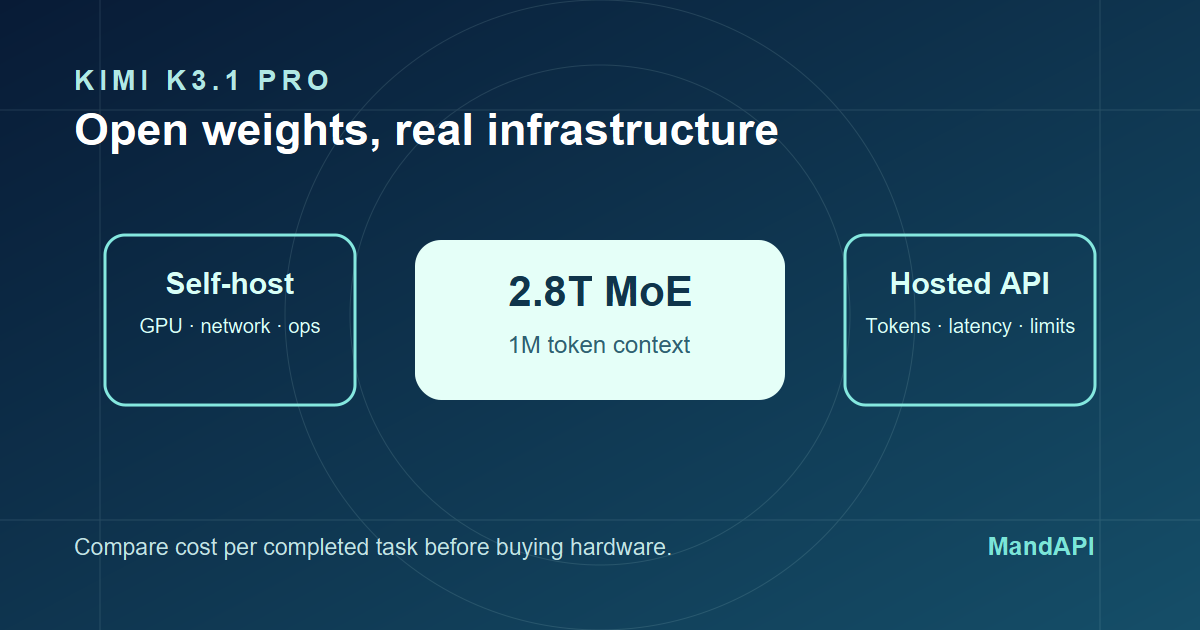
Moonshot AI has published the Kimi K3.1 Pro weights on its Hugging Face model page. The model has 2.8 trillion total parameters, 104 billion activated parameters and a stated 1,048,576-token context window. Open weights make self-hosting possible, but the deployment is a large infrastructure project.
Is Kimi K3.1 Pro open source?
Open weight is the more precise term. The weights are downloadable under the Kimi K3.1 Pro license; review its terms before redistribution or commercial deployment. The official model card describes an MoE architecture, MXFP4 weights, KDA plus Gated DSA attention, and text and image input. Its one-million-token context limit is a model capability, not a promise that every server setup can serve that length at useful concurrency.
What hardware does local deployment require?
The checkpoint takes roughly 1.5 TB of storage, while inference also needs memory for KV cache, runtime buffers and simultaneous requests. The public vLLM K3.1 Pro recipe describes several qualified configurations. These include an eight-GPU B300 node for some workloads and, on Zhenwu hardware, four eight-PPU M890 nodes (32 PPUs total) or two 16-PPU 810E nodes. These are hardware-specific recipes, not interchangeable memory totals. Two M890 boxes having enough combined HBM to hold weights does not establish a supported production setup.
The SGLang cookbook also distinguishes low latency from high concurrency and long-running agents. Benchmark the actual prompt length, traffic and latency target before buying hardware.
Does self-hosting really start at ¥8 million?
Moonshot AI does not publish a universal fixed self-hosting price. Online estimates of about ¥8 million for two M890 machines or ¥30 million for eight machines assume a particular per-node quote and networking cost. They are neither an official price nor a validated minimum for K3.1 Pro. Real total cost also includes high-speed networking, power, storage, operations and utilization. The four-M890 vLLM recipe does not attach a public bill of materials or procurement quote.
| Route | Best fit | Check before committing |
|---|---|---|
| Hosted API | Trial use and variable demand | Token price, latency, limits and data handling |
| Self-hosting | Sustained load or infrastructure-control needs | Qualified topology, cache, network and total cost |
| Smaller model | Uncertain budget or workload | Task quality and cost per completed job |
How does K3.1 Pro compare with K3?
In its official announcement, Moonshot credits larger-scale post-training and reinforcement learning. Its Terminal-Bench 4.0 table reports 65.7% for K3.1 Pro, 58.2% for GPT-6 Astra and 66.4% for Claude Opus 5.5. The company also reports 61.2% on its internal Kimi Code Bench 3.0 Long-horizon, up from 55.95% for K3. These numbers come from vendor-reported evaluations with differing agent setups; run representative tasks before treating them as a cost comparison.
How do I call the Kimi K3.1 Pro API?
Moonshot offers kimi-k3.1-pro and a Highspeed variant through its API platform. The model card describes OpenAI- and Anthropic-compatible interfaces, with reasoning_effort values low, high and max (default max). For multi-turn tool use, pass back the full assistant message, including reasoning_content and tool_calls.
On MandAPI, the public catalog, checked November 5, 2026, lists kimi-k3, kimi-k2.8 and kimi-k2.7-code, but does not yet list K3.1 Pro. Explore available models through Models and current prices on Pricing. Do not send the K3.1 Pro ID to MandAPI until it appears in the catalog and your account.
FAQ
Can I run the full model on one ordinary GPU?
No. The official checkpoint is far larger than the memory of a conventional single GPU. Third-party quantizations are a separate deployment choice and need separate validation.
Are two M890 nodes enough?
Aggregate HBM alone is insufficient evidence. The public vLLM Zhenwu recipe above documents four eight-PPU M890 nodes.
API or purchased servers?
Compare cost per completed task, including reasoning tokens, retries, latency and operations. Buy hardware only after measuring the intended workload and data-control requirements.