 MandAPI
Did Claude prove the Riemann Hypothesis? What Lean has verified
Updated November 22, 2026. This report separates the formal proof community's verification from the Millennium Prize process.
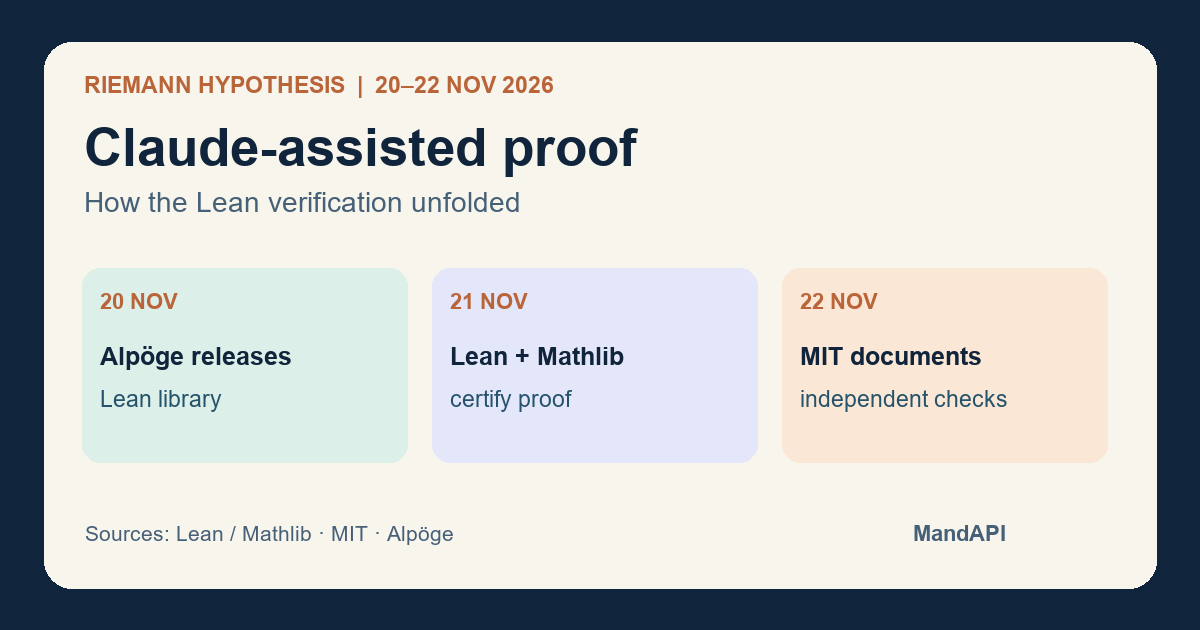
Short answer: Mathematician and Anthropic researcher Levent Alpöge released a Claude-assisted proof on November 20. On November 21, the Lean and Mathlib communities said they had full confidence in it and certified that the formal library proves the correct statement. The Clay Mathematics Institute's public page still labels the problem Unsolved as checked on November 22. Verification of a formal proof and recognition under Clay's prize process are separate developments.
What did Alpöge and Claude release?
In a four-page note, Alpöge says he and Claude found a proof of the Riemann Hypothesis and an extension to the generalized hypothesis for Dirichlet L-functions. He also released a Lean library of roughly 17 million lines. A complete human-readable mathematical exposition has not yet been published; Alpöge says he intends to explain and simplify the argument.
The Riemann Hypothesis says every nontrivial zero of the Riemann zeta function has real part 1/2. The location of these zeros governs how precisely mathematicians can describe the distribution of prime numbers. Checking even trillions of zeros is not a proof about every zero.
Alpöge credits Claude with a crucial late-stage suggestion involving a chain of theta lifts of length about the square root of X. That is his account of a collaboration, not evidence that a chatbot independently settled the question without a mathematician's direction or subsequent proof checking.
How was the formal proof checked?
The joint Lean and Mathlib statement sets out four tests. The statement matches Mathlib's established definition; the library compiles; independent comparison tools confirm the theorem proved is the intended statement; and proof checkers accept the exported argument. These checks address a central concern in computer-assisted proofs: code can compile while proving the wrong proposition.
On his MIT verification page, updated at 04:35 UTC on November 22, Andrew Sutherland reports that 175,187 modules compiled and that the five headline theorems use only three standard axioms. An isolated rebuild reproduced an exported proof of about 61.6 GB byte for byte. The independent nanoda and con-leche checkers accepted that export. Some additional kernel runs were still in progress at the time of that update; the exact status of each check matters even though the joint community statement had already endorsed the result.
Sutherland also combined the formalization with an independent Lean library for the Robin and Lagarias criteria, deriving the corresponding arithmetic inequalities. This is a useful cross-check, not a substitute for the longer task of understanding and explaining the mathematical ideas behind millions of lines of formal proof.
Did Claude do it alone? Has Clay awarded the $1 million prize?
No single-agent story captures Alpöge's account. He describes guiding the mathematical program while Claude supplied important technical ideas. Nor is there a Clay announcement awarding the $1 million prize as of this update. Clay's page still says Unsolved. That administrative status does not itself contradict Lean and Mathlib's formal verification; the organizations serve different roles.
The scope of the “generalized” result also matters. MIT's checked statements cover Dirichlet-character L-functions. They do not automatically prove corresponding claims for all Dedekind, Hecke or automorphic L-functions.
What does this mean for AI developers?
This case offers a concrete workflow: a mathematician directs an investigation, an AI model helps construct arguments, and a formal system makes them checkable. The next challenge is to turn an enormous verified object into mathematics people can read, simplify and build upon.
For your own model experiments, see MandAPI's model catalog, current pricing and OpenAI-compatible API guide. MandAPI did not produce or certify the mathematical proof.
Frequently asked questions
Has the Riemann Hypothesis been proved?
Lean and Mathlib certified on November 21 that Alpöge's formal library proves the correct statement. Clay's public page still displayed Unsolved when checked on November 22.
Who checked the proof?
The Lean and Mathlib communities issued the joint statement, endorsed by the Lean FRO and Mathlib Initiative. Andrew Sutherland published independent verification results and files at MIT.
Did AI do all the work without mathematicians?
No. Alpöge describes guiding the mathematical work while Claude contributed ideas and formalization. Community members then checked the resulting artifacts.
Has the Millennium Prize been awarded?
No award announcement appeared on the Clay page checked on November 22; it still marked the Riemann Hypothesis Unsolved.