 MandAPI
Open-weight model licenses in 2026: can DeepSeek, Hy4, Qwen and Kimi power a commercial API?
Updated November 20, 2026. This comparison reads the license files of specific checkpoints. Hosted API terms are separate.
Can you put publicly available model weights in a paid product? Often yes. Can you host those weights and sell general-purpose API access? That depends on the checkpoint and your business. DeepSeek V4.1 Flash 1017, Tencent Hy4, Qwen3.8-27B, Qwen3.8-Flash-Next and Kimi K3.1 Pro ship with different license terms. The model family's name is not enough to answer a commercial-use question.
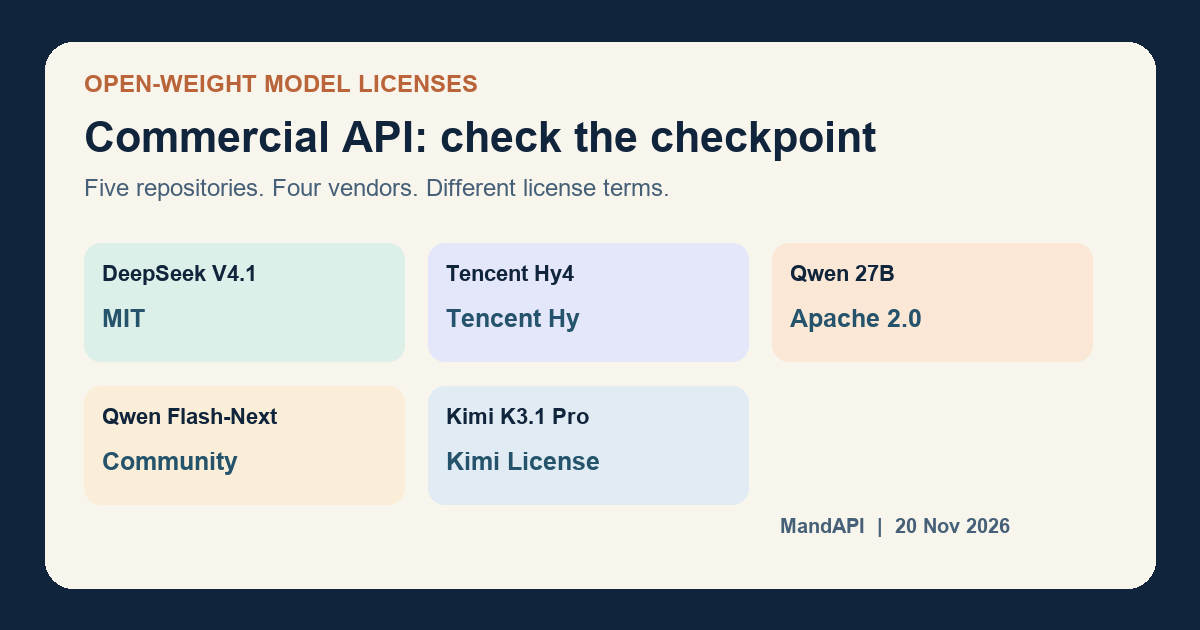
License comparison by exact checkpoint
| Published weights | Repository license | Commercial-use point to check |
|---|---|---|
| DeepSeek V4.1 Flash 1017 | MIT | Broad commercial permission; keep the copyright and license notice. |
| Tencent Hy4 | Tencent Hy License 1.0 | Running a MaaS service with the weights can trigger a separate-license requirement at Section 10's thresholds. |
| Qwen3.8-27B | Apache 2.0 | A permissive license, subject to its notice and other conditions. |
| Qwen3.8-Flash-Next | Qwen Community License 1.0 | Commercial MaaS or an AI Work Assistant requires a separate license; very large products have a UI naming rule. |
| Kimi K3.1 Pro | Kimi K3.1-Pro License | A weights-hosted MaaS business needs an agreement above US$20 million in aggregate revenue over 12 months. |
These rows describe the linked repositories, not every service with a similar model name. A hosted API may have its own model ID, operator and contract.
DeepSeek MIT and Qwen 27B Apache: what permissive means
The DeepSeek V4.1 Flash 1017 model card says its published repository and weights are under MIT. Its license permits commercial use, modification and distribution while requiring the copyright and permission notices in copies or substantial portions. This MIT file has no MaaS, revenue or user-count threshold. The license for downloadable weights does not replace the terms of DeepSeek's hosted API.
Qwen illustrates why checkpoint names matter. Qwen3.8-27B has Apache 2.0, while Qwen3.8-Flash-Next has a community license. Neither “all Qwen 3.8 is Apache” nor “all Qwen 3.8 restricts MaaS” describes these repositories accurately. Check the exact weights revision you plan to use.
Hy4, Qwen Flash-Next and Kimi: three different MaaS tests
The Tencent Hy License 1.0, which the Hy4 model card identifies as its license, defines MaaS as giving third parties remote inference or fine-tuning access with control over inputs, parameters or training data. If a business operating the Hy4 weights as MaaS exceeds US$50 million in aggregate worldwide gross revenue in any consecutive 12 months, or uses the model for a product with over 100 million monthly active users, Section 10 calls for a separate written license. It excludes defined feature-specific end-user products and mere relaying to independently operated third-party services; qualifying internal use is also excepted.
The Qwen Community License for Flash-Next is different: a business conducting commercial MaaS or an independent coding or office-productivity AI Work Assistant must obtain a separate license before commercial use of those weights or derivatives. This requirement is not conditional on reaching 100 million users. That user threshold, or US$20 million in monthly revenue, instead triggers a prominent model-name display requirement for large commercial products. The license separately describes internal use and excludes mere relaying to another host from its MaaS definition.
The Kimi K3.1 Pro license requires a separate agreement for a MaaS operator when the licensee and affiliates exceed US$20 million in aggregate revenue during any consecutive 12 months. A commercial product with over 100 million monthly active users or over US$20 million monthly revenue must prominently show “Kimi K3.1-Pro” in its UI. The license exempts internal use and access through Moonshot's official products or certified inference partners from those two requirements. It does not demand prior permission from every small commercial app.
Distillation and “open source” need precise language
Tencent expressly includes fine-tuned, quantized, merged, pruned and distilled versions of model weights in its definition of derivative works. Teams training a new model should examine that language closely. Yet declaring that every use of generated outputs for distillation is automatically a derivative work in every situation goes beyond what this comparison establishes. Qwen and Kimi also address derivative works in parts of their licenses, but the Kimi text reviewed here does not impose a blanket “relicense every derivative under identical terms” rule.
A permissive license for weights is also different from “Open Source AI” under the Open Source Initiative's definition, which considers training-code and data information as well as parameters. An MIT or Apache file tells you something important about permissions; by itself, it does not certify the entire AI system against that definition.
What does this mean for a MandAPI user?
To test models through an API without buying a GPU cluster, browse MandAPI's model catalog and BRL pricing. On November 20, its public price catalog listed service IDs including deepseek-v4.1-flash-1017, qwen3.8-flash and hy4-preview. Those service IDs do not establish the license of a particular downloaded checkpoint behind any provider.
The Hy4, Qwen Flash-Next and Kimi license definitions distinguish operating weights from merely relaying requests to an independent service. That distinction does not remove the API provider's terms or settle a self-hosting or training project. For an integration path, see the OpenAI-compatible API guide. For model-specific context, read DeepSeek V4.1 Flash 1017 (Portuguese) and Kimi K3.1 Pro.
Frequently asked questions
Can I sell an API powered by downloaded DeepSeek V4.1 Flash 1017 weights?
The repository's MIT license has no MaaS threshold and permits commercial use with its notice requirement. Check any other components, data and service agreements involved.
Does every Qwen 3.8 checkpoint use the same license?
No. The Qwen3.8-27B repository reviewed here uses Apache 2.0; Qwen3.8-Flash-Next uses Qwen Community License 1.0.
Is API relaying the same as hosting model weights?
The MaaS definitions in the Hy4, Qwen Flash-Next and Kimi licenses distinguish mere relaying to independent services. The contracts governing those services still matter.
Is model distillation always banned?
These checkpoints do not establish a universal ban. Tencent names distilled weight versions as derivatives; review the applicable checkpoint license and training method before distributing a new model.